Views: 0 Author: Site Editor Publish Time: 2026-08-04 Origin: Site

Fluid transfer systems rely on managing pressure differentials. When industrial or agricultural pumps operate, they generate negative pressure to draw fluids into the casing. This vacuum exerts massive external force on the suction line. Using an unreinforced hose on the inlet side guarantees failure. The hose wall collapses, choking the flow. This restriction causes immediate pump cavitation, destroying impellers and causing severe equipment downtime. A rigid helix is a mandatory structural requirement for any functional suction line. It prevents collapse and maintains the internal diameter under heavy vacuum. This guide breaks down helix mechanics, material trade-offs, and specification criteria. We will examine how to evaluate and procure the correct flexible PVC suction hose for your specific site requirements.
Vacuum Resistance is Mandatory: A rigid helix prevents the hose wall from collapsing under the negative pressure required to draw fluids into a pump.
Flexibility vs. Rigidity Trade-off: The design of the helix dictates the bend radius; tighter pitches increase crush resistance but reduce the maneuverability of a flexible PVC suction hose compared to lay-flat discharge hoses.
Application Dictates Material: Selecting between exposed PVC helices, embedded wire, or polyurethane (PU) depends entirely on chemical exposure, abrasive solids, temperature extremes, and whether you are conveying liquids, gases, or dry bulk.
Installation Requires Technique: Because of the rigid helix, fitting installation is notoriously difficult; field operators must use specific temperature management and compatible lubricants to avoid hose damage or joint failure.
A successful suction line must maintain 100% of its internal diameter under maximum vacuum. This operational parameter defines the core difference between suction and discharge lines. Discharge hoses handle internal outward pressure. They require tensile strength provided by woven yarn reinforcement. Because the pressure pushes outward, these hoses remain lightweight and lay flat when empty. Suction hoses face the exact opposite force. When internal pressure drops below one atmosphere, external atmospheric pressure pushes inward with immense force.
This structural difference creates a strict flexibility trade-off. Lay-flat discharge hoses offer superior maneuverability around site obstacles. You can roll them up easily and deploy them rapidly. The structural rigidity required for suction limits the hose bend radius and routing flexibility. If a suction line lacks this rigidity, atmospheric pressure flattens it instantly. A collapsed line restricts fluid volume entering the pump. This starvation leads to vapor bubble formation inside the pump casing. We call this cavitation.
Cavitation is highly destructive. When vapor bubbles enter the high-pressure side of the pump impeller, they implode violently. These micro-implosions blast small pits into the metal impeller blades. Over time, this pitting destroys the impeller balance, ruins mechanical seals, and forces a total pump replacement. Understanding the mechanics of your pump inlet hose prevents these catastrophic failures.
| Feature | Suction Hose | Discharge Hose |
|---|---|---|
| Primary Force | External atmospheric pressure (Vacuum) | Internal fluid pressure |
| Reinforcement Type | Rigid Helix (PVC, Steel, PU) | Woven Yarn / Textile |
| Resting State | Maintains full round shape | Lays flat |
| Flexibility | Limited by helix bend radius | Highly flexible |
| Failure Mode | Wall collapse, pump cavitation | Wall burst, fluid leak |
Field operators must recognize the early warning signs of a failing suction line. If the hose begins to oval or flatten during operation, the vacuum rating is insufficient for the pump's draw. You will hear a distinct rattling sound inside the pump casing, often described as pumping gravel. This sound confirms active cavitation. Immediate shutdown is required to prevent mechanical damage. Upgrading to a properly rated hose with a robust helix solves this issue.
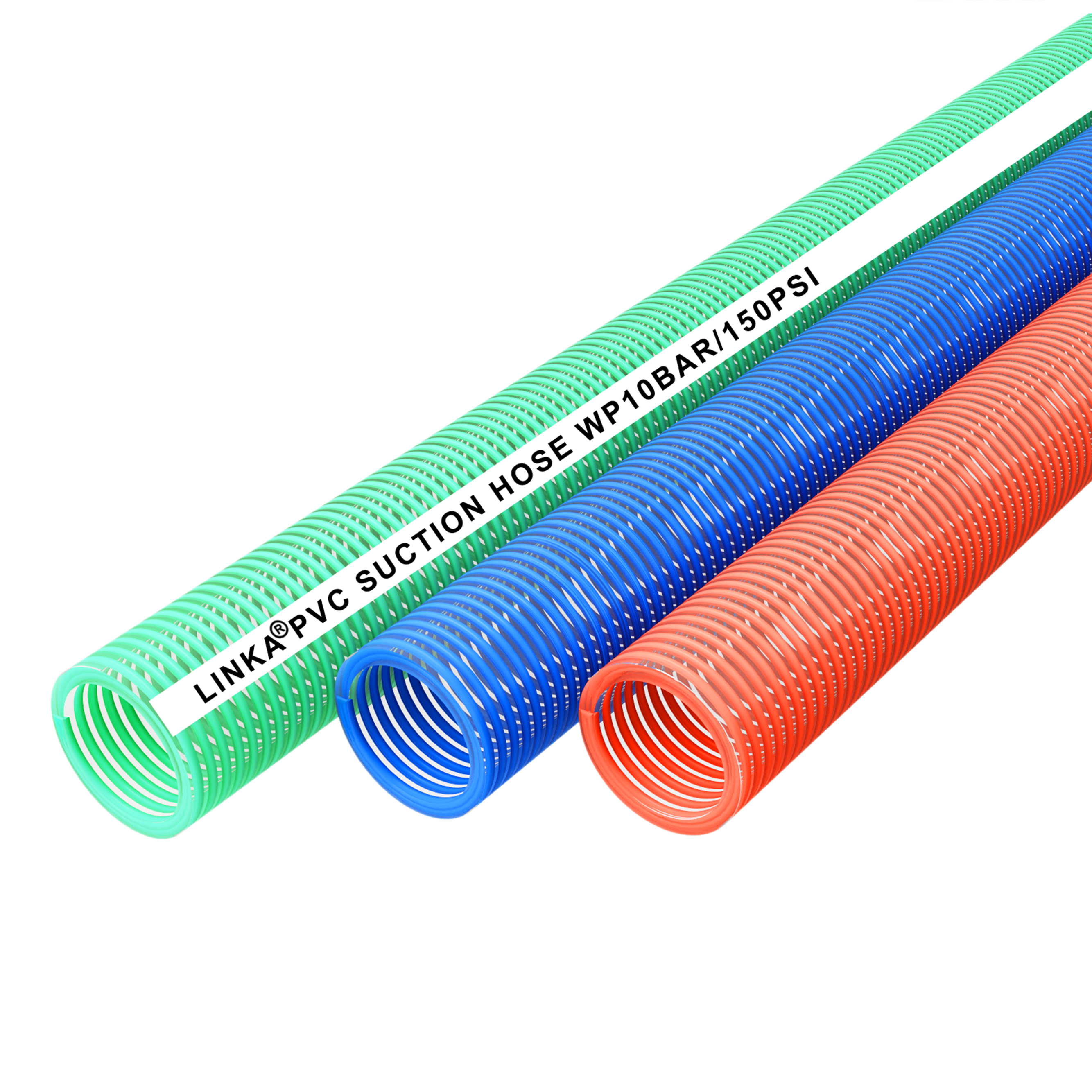
The rigid helix acts as a continuous skeletal arch within the hose wall. This architectural function distributes external atmospheric pressure evenly across the surface. By maintaining the circular cross-section, the helix prevents the flexible PVC webbing from caving inward. Beyond vacuum resistance, the helix provides heavy-duty crush resistance. It protects the hose from external physical impacts common on job sites. Tractors run over them in agricultural settings. Workers step on them. Trucks drag them across sharp gravel.
Maintaining continuous flow rates is the primary goal. The helix holds the internal walls taut, creating a smooth inner bore. This smooth surface minimizes friction loss and fluid turbulence. When fluid travels through a corrugated or collapsed interior, turbulence increases, dropping the overall efficiency of the transfer system. You must evaluate the internal smoothness against the required Gallons Per Minute (GPM) of your pump.
Friction loss calculations dictate the required internal diameter (ID) of your hose. If you select a hose with an ID too small for your pump's GPM rating, fluid velocity increases. High fluid velocity increases friction against the hose wall, which in turn increases the vacuum pressure required to pull the fluid. This compounding effect puts unnecessary stress on the helix. Sizing the hose correctly ensures the helix operates within its designed safety margins.
Determine the maximum GPM output of your pump.
Consult friction loss charts to find the optimal hose ID for that GPM.
Verify the selected hose ID matches the pump inlet port exactly.
Check the manufacturer's vacuum rating (in Hg) for the selected hose.
Ensure the operating temperature remains within the specified limits to maintain helix rigidity.
The integration of the helix into the PVC wall varies by manufacturing technique. Some hoses feature an exposed external helix. This design acts as a wear strip, taking the brunt of abrasion when dragged across concrete. Other designs embed the helix completely within the PVC wall, creating a smooth outer cover that is easier to clean and clamp. Your site conditions dictate which construction method performs best.
Selecting the right material for your PVC Suction Hose depends entirely on the media you transfer and the site environment. A standard PVC helix is cost-effective and lightweight. It works perfectly for standard water transfer, washdown, jetting, and general agricultural use. However, standard PVC degrades quickly when exposed to highly abrasive materials.
A Polyurethane (PU) helix or internal lining offers superior abrasion resistance. You need PU when suctioning dry solids, dust, wood fibers, or abrasive slurries. Industrial dust removal and extraction equipment rely heavily on PU-reinforced hoses to prevent premature wear. A steel wire helix provides the maximum vacuum rating and crush resistance available. It handles extreme negative pressure without deforming. Steel wire is highly durable but adds significant weight to the hose assembly. It also remains susceptible to corrosion if the inner PVC layer breaches and exposes the wire to corrosive fluids.
The distance between the spiral loops, known as pitch, significantly affects hose performance. A narrow pitch places the helix coils close together. This configuration provides a higher vacuum rating and greater crush resistance. The trade-off is lower flexibility. A wide pitch spaces the coils further apart. This allows for easier routing around obstacles and tighter bend radii, but it increases the risk of kinking under high vacuum or when bent too sharply.
| Material | Best Application | Pros | Cons |
|---|---|---|---|
| Standard PVC | Water transfer, agriculture | Lightweight, cost-effective | Low abrasion resistance |
| Polyurethane (PU) | Abrasive slurries, dry solids | High abrasion resistance | Higher cost |
| Steel Wire | Heavy dewatering, high vacuum | Maximum crush resistance | Heavy, corrosion risk |
Visual monitoring capabilities influence hose selection. A clear suction hose with a white helix allows operators to visually confirm fluid flow. You can spot blockages instantly. You can identify air leaks by watching for bubbles entering the stream. This visibility is highly useful for washdown and jetting applications. Conversely, a green PVC suction hose, or other opaque options, serves as the industry standard for outdoor setups. Opaque walls provide superior UV resistance. They block sunlight, preventing algae growth inside the hose during stagnant periods. They also conceal internal wear and staining from muddy water.
Different industries demand specific hose characteristics. For agricultural and irrigation use, an irrigation suction hose must withstand harsh outdoor conditions. UV stabilization prevents the PVC from becoming brittle under direct sunlight. The material must resist chemical degradation from fertilizers and herbicides mixed into the water supply. The external helix must provide high drag resistance to survive being pulled across rough soil, rocks, and crops.
Industrial and heavy-duty dewatering applications present different challenges. Construction sites and mining operations require a reinforced PVC water hose with massive crush resistance. Heavy machinery constantly threatens the hose lines. The hose must tolerate suspended solids like mud, sand, and gravel without wearing through the inner wall. Compatibility with heavy-duty trash pumps is mandatory, requiring high vacuum ratings and secure clamping surfaces.
Industrial ventilation and material handling utilize light-duty flexible PVC suction hoses. These hoses handle gaseous media, industrial dust, wood shavings, and fiber extraction. Because they do not transfer heavy liquids, they feature thinner walls and wider helix pitches to maximize flexibility. They often incorporate static-dissipating wire to prevent combustible dust explosions.
Food grade and potable water compliance require strict material controls. You must select FDA or NSF-approved PVC compounds. The manufacturing process must ensure the PVC and the helix do not leach harmful plasticizers or chemicals into the conveyed media. These hoses typically feature completely clear walls to ensure absolute cleanliness and visual inspection during sanitation cycles.
Installing fittings on a rigid, helix-reinforced hose challenges even experienced field operators. You must force heavy-duty aluminum or poly camlock shanks into a rigid hose ID. The helix fights expansion. Never use petroleum-based grease or motor oil to ease this installation. Petroleum chemically degrades and swells PVC. This degradation leads to early hose-coupling failure and dangerous blowouts under pressure.
Proper temperature management solves installation struggles. Submerge the hose end in a hot water bath for several minutes. The heat temporarily softens the PVC webbing without melting the rigid helix. Never use open flames or torches, as they will scorch the plastic and destroy the structural integrity. Once the PVC softens, apply a compatible lubricant. Soapy water, vegetable oil, or dedicated silicone-based lubricants allow the fitting barb to slide in smoothly.
Temperature variables dictate operating limits in the field. Near-freezing temperatures turn flexible PVC completely rigid. If you attempt to bend a cold hose past its minimum radius, the PVC webbing will crack between the helix coils. Conversely, high ambient temperatures or hot fluids soften the PVC. This softening reduces the vacuum rating significantly. The hose risks structural collapse and helix failure under negative pressure when operating near its maximum temperature limit.
Always cut the hose perfectly square before inserting fittings.
Use a hot water bath (150°F - 180°F) to soften the hose end.
Apply non-petroleum lubricants to the fitting barb.
Push the fitting in with a steady, twisting motion.
Allow the hose to cool completely before applying clamps.
Proper clamping and sealing prevent vacuum leaks. Standard worm-gear clamps fail on corrugated outer walls. They cannot apply even pressure across the helix ridges, leaving gaps where air enters the suction line. Air leaks destroy pump prime. You must use spiral double-bolt clamps, T-bolt clamps, or banded clamping methods. These heavy-duty clamps bridge the external helix, compressing the hose wall evenly against the fitting barb for an airtight seal.
A rigid helix serves as the foundational engineering element that allows a PVC suction hose to function. It actively prevents catastrophic pump cavitation and line collapse under heavy negative pressure. Matching the correct helix material and pitch to your specific site conditions ensures reliable fluid transfer and protects your expensive pumping equipment from premature failure.
Prioritize clear-with-white-helix hoses for applications requiring visual flow monitoring. Select UV-resistant green or opaque hoses for permanent outdoor agricultural irrigation setups. Upgrade to polyurethane or steel wire reinforcements when handling severe abrasive materials or operating under extreme vacuum conditions.
Verify your pump's maximum vacuum rating in inches of mercury (in Hg).
Measure your required bend radius to ensure the hose can route without kinking.
Consult manufacturer specification sheets to match the exact helix type to your application.
Procure spiral double-bolt clamps to guarantee an airtight seal on corrugated hoses.
A: No. Regular garden hoses and lay-flat discharge hoses lack a rigid helix. They will collapse immediately under the negative pressure generated by the pump, restricting flow and causing severe pump damage through cavitation.
A: Discharge hoses are highly flexible and lay flat when empty because they only handle internal pressure. Suction hoses require a rigid helix to withstand external atmospheric pressure, which significantly limits their bend radius and maneuverability.
A: Your hose is collapsing because it lacks a rigid helix, the helix is physically damaged, or the hose is operating beyond its rated vacuum capacity or temperature limits, causing the material to soften and fail.
A: Never use petroleum-based products. They chemically degrade and swell PVC, leading to premature hose failure and coupling blowouts. Use soapy water or silicone-based lubricants instead.
A: Submerge the end of the hose in hot water for a few minutes. This safely softens the PVC material without melting or damaging the structural integrity of the rigid helix. Do not use open flames.


