Views: 0 Author: Site Editor Publish Time: 2026-10-26 Origin: Site

Ever stood in ankle-deep mud watching water spew from a ruptured line during a critical pumping job? Choosing the wrong conduit often leads to sudden pressure drops. Flooded job sites quickly follow. Then comes the costly operational downtime. Fortunately, selecting the right equipment does not have to be a guessing game.
In this comprehensive guide, you will learn exactly how to select the perfect PVC layflat hose for your specific water transfer needs. By understanding pressure ratings, sizing, and material grades, you can ensure peak efficiency and prevent catastrophic blowouts on the job site.
Recent industry analyses highlight a significant shift in fluid management trends. Extreme weather events now demand rapid, high-volume dewatering solutions. Meanwhile, the rapid expansion of precision agriculture requires highly adaptable irrigation networks. Traditional rigid pipes offer permanence but severely lack mobility. Standard thick-walled rubber hoses are incredibly durable but often prohibitively heavy. They become a logistical nightmare for a single operator to maneuver in deep mud.
This flexible piping bridges the gap flawlessly. It provides a highly engineered solution specifically designed for moving massive volumes of liquid efficiently across unpredictable terrains.
The defining characteristic of this equipment is its collapsible design. Rigid pipes maintain a tubular shape when empty. In contrast, these flexible lines flatten completely when de-pressurized. Crews can roll hundreds of feet of material into a tight, compact coil. For agricultural workers and construction teams, this translates to rapid deployment across sprawling fields. Effortless transport and space-saving storage in utility sheds naturally follow.
The strength of these fluid delivery systems stems from a unique manufacturing process. Premium liquid polyvinyl chloride is fused with a high-tensile woven polyester yarn reinforcement via continuous extrusion. Specifically, this embedded synthetic grid provides exceptional tensile strength. It prevents the line from elongating under intense pressure while offering substantial resistance to kinking. Compared to heavy-duty rubber alternatives, it offers a much more economical price point without sacrificing structural integrity.
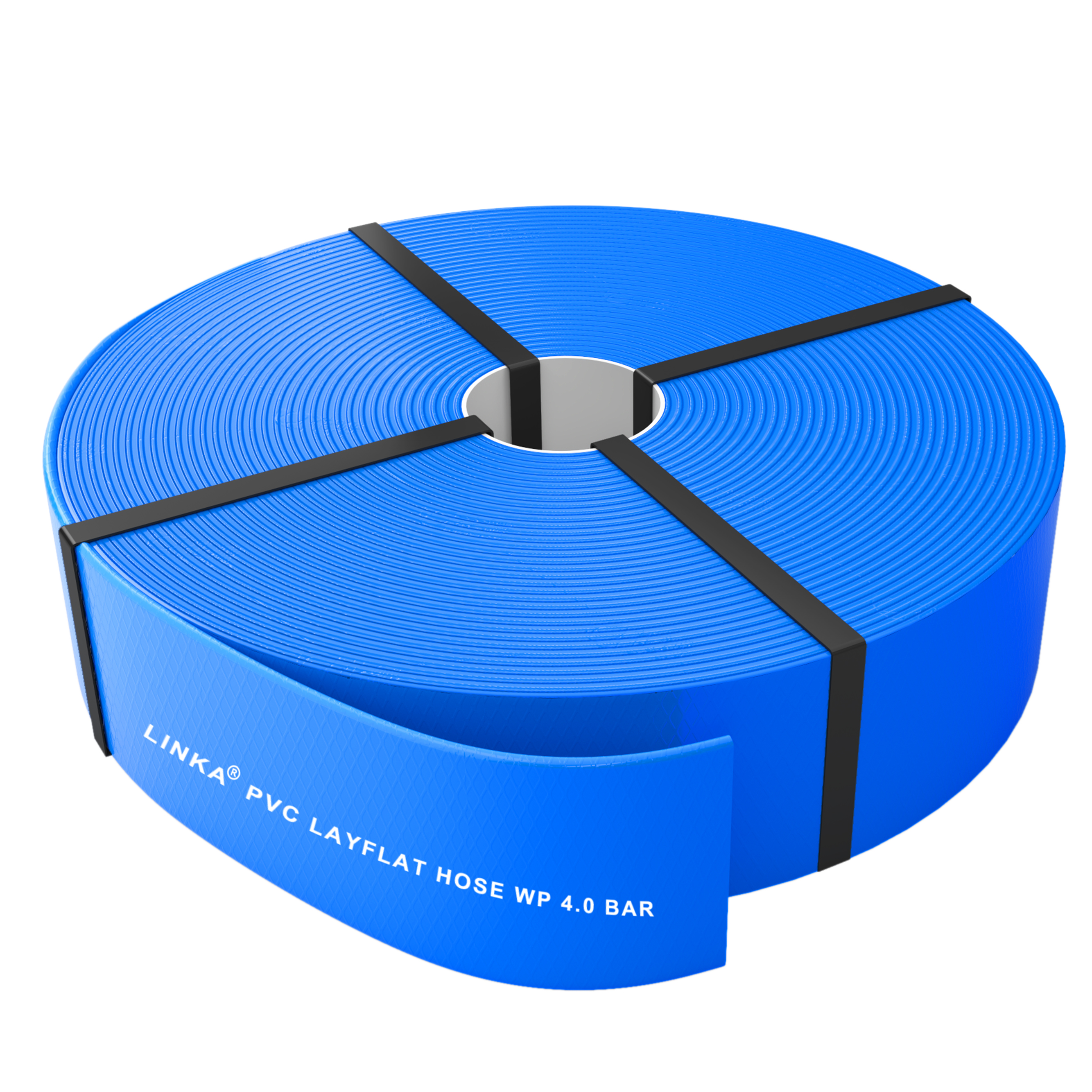
One of the most common questions buyers have when evaluating a PVC flat hose is the significance of the exterior color. In the industrial market, colors act as standardized visual indicators. They dictate wall thickness, pressure rating, and intended duty cycle.
Blue variants are the industry standard for light to medium-duty applications. They feature a thinner outer wall. This makes them exceptionally lightweight and highly flexible for quick deployment.
They work best for open-end water discharge, light agricultural watering, and temporary flood removal. Standard-duty blue lines typically feature a working pressure ranging from 30 PSI to 80 PSI, depending on the internal diameter.
Furthermore, red hoses are engineered for highly demanding environments. They boast a significantly thicker polymer wall and a denser polyester yarn weave. This construction delivers superior abrasion resistance and much higher pressure tolerances.
These are ideal for high-pressure transfer and heavy construction dewatering. Red hoses generally handle continuous working pressures between 100 PSI and 150 PSI. Their robust build easily resists external punctures when dragged across rough gravel or exposed rebar.
Selecting the correct water discharge hose requires matching technical specifications to your pump output. Failing to align these factors inevitably results in reduced flow rates or complete system failure.
The Inside Diameter is the single most critical measurement. Sizes typically range from 1 inch for small utility pumps up to 12 inches for massive municipal bypass systems.
The fundamental rule of fluid dynamics is simple. Never undersize your conduit compared to your pump outlet. Forcing liquid from a 3-inch trash pump into a 2-inch restriction creates severe friction loss. This dramatically reduces your gallons-per-minute output. It also forces the pump mechanical seals to overheat.
Understanding pressure ratings is vital for job site safety. Manufacturers list two distinct metrics. Confusing them can lead to dangerous blowouts.
The Working Pressure is the maximum safe operating limit that the material is engineered to handle continuously. Your pump maximum output must never exceed this number. Conversely, the Burst Pressure is the absolute maximum spike the material can withstand before structural integrity fails. Industry standards dictate a 3 to 1 safety margin. Always base purchasing decisions strictly on the Working Pressure.
To simplify your procurement process, use this standard specification matrix based on premium industrial standards.
| Inside Diameter | Duty Grade | Working Pressure | Best Application |
|---|---|---|---|
| 1.5 Inch to 2 Inch | Standard Blue | 60 to 80 PSI | Pool draining, light utility pumps |
| 3 Inch to 4 Inch | Standard Blue | 45 to 60 PSI | Agricultural drip mains, flood relief |
| 3 Inch to 6 Inch | Heavy Red | 115 to 150 PSI | Trash pumps, mine dewatering |
| 8 Inch to 12 Inch | Heavy Red | 35 to 60 PSI | Municipal sewer bypass |
To maximize your return on investment, the equipment must fit the specific demands of the task. The physical stresses in an agricultural field differ vastly from those on an active urban construction site.
In modern commercial farming, these conduits serve as a reliable irrigation hose to feed secondary drip tape. Automated emitters inherently generate internal backpressure. A key advantage of this reinforced material is customization. Farmers can use specialized hole punches to pierce the wall and insert barb fittings directly into the line. This creates a highly customized, leak-free manifold for crop rows.
Construction sites require robust dewatering solutions to manage groundwater. This water is rarely clean. It comes laden with abrasive silt, sand, and small gravel. For this heavy-duty application, a thick-walled red variant is mandatory. It resists internal scouring caused by sand and external tearing from heavy machinery traffic.
The operational integrity of any system is only as strong as its weakest connection point. Standard garden-style fittings are entirely inadequate here. Secure, industrial-grade connections are required to handle the volumetric force.
Camlock fittings are the gold standard for rapid, reliable connections. They consist of a male adapter and a female coupler equipped with two cam arms. You simply slide the adapter in and press the arms down. This creates an instant watertight seal against an internal gasket. They require no tools and avoid threading issues.
Pin lug fittings feature threaded ends and a barbed shank that inserts directly into the tube. They are tightened using a specialized spanner wrench. Specifically, they provide a highly secure, semi-permanent connection. This setup is excellent for environments subjected to heavy vibration.
Proper handling during the initial deployment sets the stage for a long operational lifespan. Maximizing the lifespan of your drainage hose begins before the water even starts flowing.
Never engage the water pump while the line is still coiled. When pressurized liquid hits a kink, it creates a violent kinetic water hammer effect. This forces the line to untwist rapidly. Severe friction burns against the ground or detached fittings usually follow. Always walk the line out completely. Ensure it lies flat and straight with wide, sweeping turns before slowly throttling up the pump.
After the pumping operation concludes, disconnect the line from the manifold. Elevate one end over your shoulder and walk the entire length to force the remaining liquid out. Leaving stagnant water inside a rolled tube promotes the growth of foul-smelling mold. This is especially true if the water contained organic agricultural matter.
Once completely dry, roll the material flat into a tight coil. Never fold it. Sharp creases create permanent weak points in the polymer matrix. Store the coiled equipment indoors in a dry, well-ventilated area. Protect it from prolonged direct sunlight and rodents.
No, these products are engineered exclusively for positive pressure discharge applications. Because they lack a rigid internal wire helix, applying negative pressure will cause the walls to instantly collapse inward. This completely blocks water flow and potentially causes severe cavitation damage to your pump. For the intake side, you must utilize a rigid suction hose.
Applying surface patches or standard adhesives is generally ineffective because they cannot withstand the hydrostatic pressure generated during active pumping. The only structurally sound method to repair a puncture is to cut out the damaged section entirely. Once removed, insert a grooved metal or heavy-duty plastic hose mender into both open ends. Secure it tightly using two heavy-duty T-bolt clamps on each side.
Standard industrial and agricultural models are not safe for human consumption. The manufacturing process utilizes specific chemical plasticizers to achieve flexibility, which can leach into the water. If your application involves transferring potable drinking water, you must strictly source products that are explicitly labeled as FDA-approved or carry an NSF-61 certification.
Freezing temperatures cause thermoplastics to become stiff and brittle. Before winter storage, ensure the line is completely drained and bone dry to prevent internal ice expansion. Roll it flat into a tight coil and store it elevated on pallets in a temperature-controlled shed or garage. Do not unroll or deploy a frozen line without letting it thaw first, as the brittle plastic jacket will crack under stress.
Flow rates depend heavily on pump pressure and friction loss over distance. Generally, a standard 3-inch discharge line can efficiently handle between 250 and 350 gallons per minute. Pushing flow rates beyond this threshold drastically increases internal friction. This forces the pump to work harder and reduces overall system efficiency.
Choosing the right equipment prevents costly system failures and operational headaches. Always match your pump specifications to the correct internal diameter. Verify the continuous working pressure to choose between standard and heavy-duty grades. Finally, lock the system down with appropriate industrial fittings.
Ready to upgrade your fluid transfer setup? Stop guessing and invest in proven durability. Browse the premium selection of industrial-grade solutions at Hosebiz to find the exact specifications required for your next demanding project.


