Views: 0 Author: Site Editor Publish Time: 2026-08-23 Origin: Site

Selecting the wrong discharge equipment creates severe operational risks for fluid transfer projects. Improper specification directly causes high friction loss, suddenly ruptured lines, and incredibly costly project downtime. Engineers and site managers face hundreds of variations when setting up industrial pump systems today. Navigating dangerous sizing mismatches and unpredictable environmental constraints is critical to ensure safe, continuous flow. If you guess on pressure ratings, you risk complete system failure during peak operation.
This guide provides a proven, engineering-based framework for specifying the correct PVC Layflat Hose. You will learn exactly how to align your choice with specific pump output levels, strict pressure requirements, and harsh environmental constraints. We show you the exact steps to build a completely reliable discharge system from start to finish.
Always match the hose Inside Diameter (ID) exactly to the pump outlet size to prevent dangerous flow restriction and friction loss.
Working pressure ratings for PVC layflat drop significantly as ambient and fluid temperatures rise; factor in environmental heat during evaluation.
Heavy-duty hoses feature thicker walls and woven polyester yarn reinforcement, essential for high-abrasion environments like construction dewatering.
Secure connections are as critical as the hose itself; specify Cam and Groove or Pin Lug fittings based on deployment frequency.
Operators must first accurately frame the business problem before purchasing equipment. You need to assess if your fluid transfer requires a flexible, collapsible solution. Rigid pipes require heavy machinery and significant labor to install. A flexible hose offers incredibly easy deployment. You can roll it out across uneven terrain in minutes. It also collapses flat when depressurized. This makes storage highly efficient in cramped equipment yards.
We see several ideal use cases across different industries. Open-ended water discharge remains the most common application. Farmers and agricultural engineers frequently rely on a dedicated irrigation layflat hose for seasonal crop watering. It maneuvers easily around farm machinery. Similarly, civil contractors depend on a rugged dewatering discharge hose for rapid construction site drainage. Moving nuisance water out of trenches keeps projects on schedule.
You must also acknowledge strict mechanical limitations. Flexible thermoplastic solutions cannot handle every scenario. They are never suitable for suction applications. A layflat design instantly collapses under a vacuum. You always require a rigid, wire-reinforced line for pump intake. Furthermore, you should avoid transferring abrasive slurries containing large jagged solids. Finally, never use these flexible lines in high-pressure closed-loop systems.
You should compare upfront cost and mobility against other materials. A flexible PVC line costs significantly less initially than rigid PVC piping. It is also dramatically lighter than thick rubber discharge hoses. You sacrifice some extreme abrasion resistance found in rubber. However, you gain unparalleled maneuverability and setup speed.
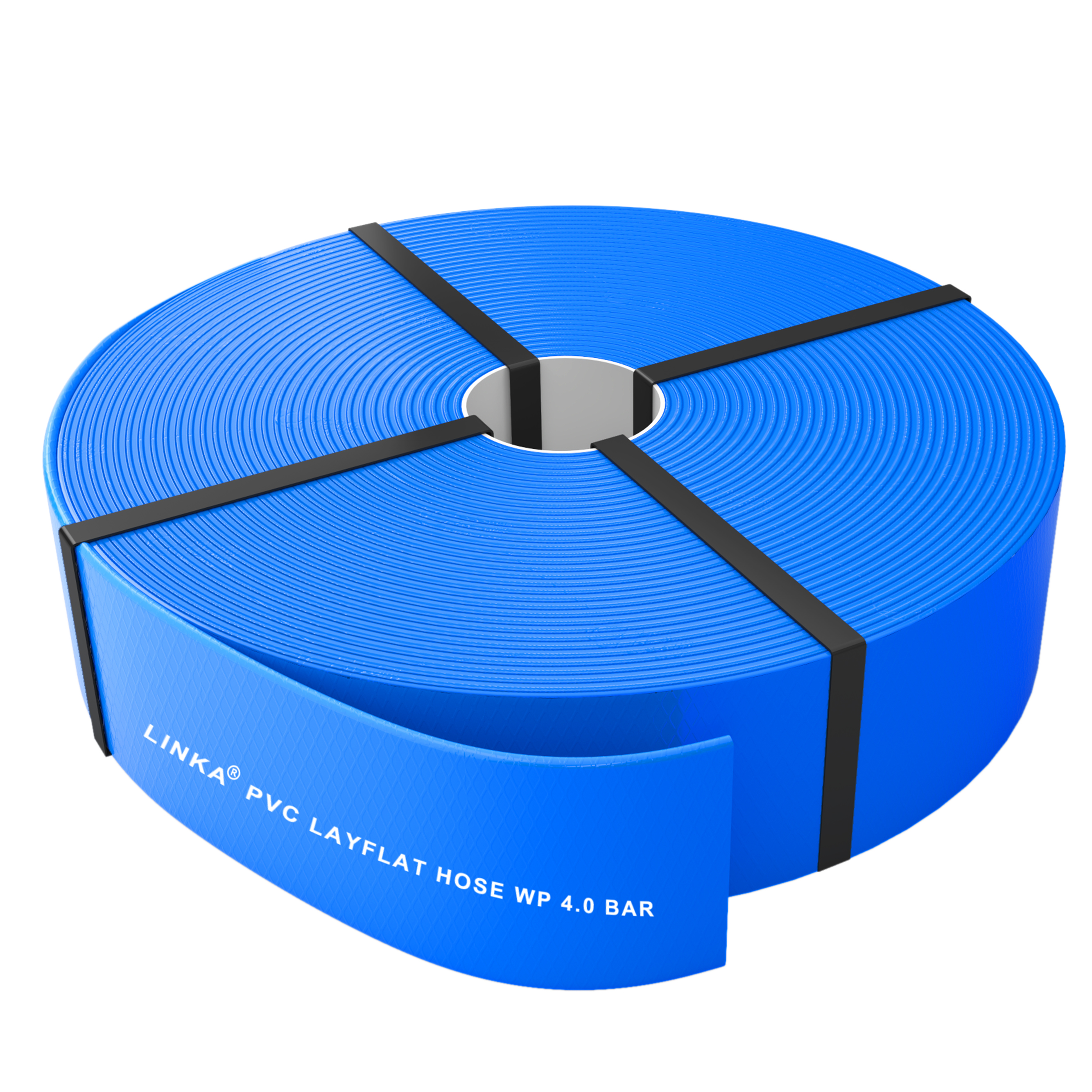
Choosing the correct physical dimensions dictates how well your system performs. Precision here prevents catastrophic pump failure. You must evaluate sizing and pressure through a strict engineering lens.
The cardinal rule of pump configuration involves precise measurement matching. The hose inside diameter must match the pump discharge port exactly. If you operate a 2-inch trash pump, you absolutely require a 2-inch ID hose. Do not attempt to neck down the output. Undersizing the line creates immediate and dangerous backpressure. Backpressure drastically reduces pump efficiency. Over time, it destroys internal pump seals and significantly reduces equipment lifespan.
Understanding pressure ratings keeps job sites safe. Manufacturers list both working pressure and burst pressure. You must follow the industry standard 3:1 safety margin. The theoretical burst pressure should always be at least three times the maximum working pressure. This safety buffer accounts for unexpected surges.
You also need to calculate your dynamic head pressure. Static head measures the vertical elevation change from your pump up to the discharge point. Pumping water uphill requires massive force. Dynamic head combines this vertical lift with the friction loss inside the tube. You must select a product rated higher than your total dynamic head calculation.
Manufacturers categorize flexible discharge lines into different duty ratings. You choose based on operational intensity.
Standard Duty: These feature thinner walls. They suit basic water transfer, residential sump pumps, and light agricultural irrigation. They remain highly flexible and very lightweight.
Heavy Duty: These endure harsh environments. They feature tightly woven polyester yarn reinforcement. The external PVC extrusion is visibly thicker. You need these for mining, quarry operations, and intense trench drainage.
Table: Standard Duty vs. Heavy Duty Performance Metrics
| Specification Feature | Standard Duty | Heavy Duty |
|---|---|---|
| Typical Working Pressure (2-inch ID) | 60 to 80 PSI | 120 to 150 PSI |
| Wall Thickness | ~ 0.05 inches | ~ 0.08 inches or higher |
| Reinforcement Style | Open weave polyester | Tightly woven synthetic yarn |
| Best Application Environment | Grass, soil, flat terrain | Gravel, rocks, heavy construction |
Site conditions dictate equipment survival. You cannot ignore ambient temperatures or ground surfaces. A reliable PVC discharge hose performs predictably only when matched to its environment.
Thermoplastics react rapidly to temperature fluctuations. Heat softens the polymer chains. As the material softens, its ability to hold internal pressure drops significantly. Engineers call this temperature derating. A line rated for 80 PSI at 68°F (20°C) performs perfectly in mild weather. However, if ambient air and fluid temperatures reach 110°F (43°C), that same line may safely handle only 40 PSI. Ignoring this reality causes unexpected ballooning and blowouts.
Cold weather presents the opposite problem. Below 15°F (-9°C), the plasticizers stiffen. The material loses its signature flexibility. Bending a frozen line often creates micro-cracks in the jacket. You must warm the material slowly before unrolling it in sub-freezing conditions.
Chart: Estimated Pressure Derating Factors for Temperature Changes
| Operating Temperature | Multiplier Applied to Max PSI |
|---|---|
| 68°F (20°C) | 1.00 (Standard Rating) |
| 90°F (32°C) | 0.80 |
| 105°F (40°C) | 0.60 |
| 120°F (49°C) | 0.40 |
Always assess the deployment surface before laying out your lines. Pulling a standard-duty line across jagged gravel or broken concrete shreds the outer jacket quickly. Once the internal polyester yarn exposes, structural failure becomes imminent. Use heavy-duty variants for rough terrain.
Ultraviolet (UV) radiation also degrades plastics over time. Sun exposure dries out the chemical plasticizers. Lines left permanently outdoors in open agricultural fields turn brittle. If you plan a permanent outdoor setup, you must verify the product contains specific UV inhibitors.
Fluid composition matters immensely. Thermoplastics handle clean water perfectly. They also tolerate mildly contaminated construction runoff without issue. Agricultural users safely pump diluted liquid fertilizers through these lines daily. However, you must verify chemical tolerance if pumping industrial waste. Harsh solvents, petroleum products, and strong acids chemically melt the extrusion. Always consult a chemical compatibility chart for specific aggressive fluids.
A fluid transfer system fails at its weakest point. Connections endure the highest stress during operation. Specifying the correct fittings ensures your lines stay securely attached under pressure.
Operators widely prefer Cam and Groove fittings for mobile applications. They represent the industry best practice for rapid, frequent deployment. You insert the male adapter and simply pull down the two female cam arms. This creates a secure, leak-free seal instantly. You do not need any tools. We recommend aluminum fittings for lightweight strength. You might choose polypropylene fittings to resist mild agricultural chemicals.
Pin lug couplings offer a traditional, cost-effective alternative. You tighten these threaded brass or aluminum fittings using a spanner wrench. They take longer to connect than camlocks. Therefore, they fit best in semi-permanent installations where you do not disconnect lines daily. They handle standard water transfer pressures exceptionally well.
How you attach the fitting to the hose jacket prevents devastating blow-offs.
Common Mistake: Many inexperienced users rely on standard, narrow worm-gear clamps. These automotive-style clamps feature serrated bands. As you tighten them over a soft thermoplastic jacket, the serrations slice directly into the material. Under high pressure, the sliced section rips completely off the fitting.
Best Practice: We strongly recommend using smooth-edge Band-It clamps. Alternatively, you can use double-bolt spiral clamps. These devices distribute clamping force evenly across a wide surface area. They secure the fitting tightly without damaging the outer extrusion or crushing the internal yarn.
Even perfectly specified equipment fails if deployed carelessly. Site managers must train their crews on routing and fluid dynamics principles to protect the investment.
Water hammer destroys piping systems instantly. Water carries immense kinetic energy when flowing at high velocity. If an operator suddenly slams a downstream discharge valve closed, the water stops immediately. The kinetic energy converts into a massive, high-speed shockwave. This pressure spike travels backward toward the pump. The sudden spike easily exceeds the theoretical burst pressure. It causes the line to split violently open. You must always open and close valves slowly to manage fluid momentum safely.
Deployment geometry affects performance. Improper unrolling restricts flow drastically. When crews throw a rolled line off a truck and pull it hastily, twists develop. A twisted line cannot inflate properly when pressurized. These twists form severe kinks. Kinks act like closed valves, creating massive backpressure. Furthermore, the sharp creases stress the polymer matrix. Over time, these creased areas become permanent weak points prone to pinhole leaks. Always walk the line out completely and untwist it before starting the pump.
Pumping fluids vertically introduces extreme mechanical stress. Water is incredibly heavy. When you route a line up the side of an excavation trench, the entire weight of that vertical water column pulls downward. This sheer gravitational weight stretches the plastic. It places immense tension on the upper couplings. You must physically secure the hose along vertical drops using wide support straps. Never let the line dangle freely. Securing it prevents dragging, eliminates coupling stress, and stops dangerous swaying during pump surges.
Specifying industrial transfer equipment requires a logical, step-by-step approach. You cannot simply buy the cheapest option available. You must follow the shortlisting logic closely. First, verify your pump outlet size to ensure a perfect inside diameter match. Second, calculate your maximum dynamic head pressure to maintain a safe 3:1 burst margin. Next, adjust your pressure expectations based on environmental heat and surface abrasion risks. Finally, select the appropriate coupling type based on how frequently you deploy the system.
Take these actionable next steps to finalize your setup:
Inspect your current pump manuals to confirm exact discharge port dimensions and maximum flow rates.
Map out your site terrain to identify sharp rocks, steep vertical climbs, or high-traffic crossing areas.
Consult technical specification charts to find the exact pressure derating for your local summer climate.
Contact dedicated engineering support to match a specific product directly to your unique pump curve.
A: No. Layflat hoses collapse completely under vacuum pressure. You must always use a rigid, wire-reinforced suction hose for the intake side to maintain an open pathway for fluid entry.
A: Drain the line completely after use. Roll it flat carefully to avoid permanent sharp creases. Store it indoors away from direct sunlight, chemicals, and extreme temperature fluctuations to prevent material degradation.
A: Weeping often indicates micro-punctures. Dragging the jacket over abrasive surfaces causes this. It also happens if you exceed the maximum working pressure, which overstretches and compromises the internal woven polyester reinforcement.
A: Generally, blue indicates standard or medium duty. Red or brown typically indicates heavy-duty performance with higher pressure ratings and thicker walls. However, always verify actual PSI specifications rather than relying solely on color coding.


